Helvetic Ruby 2026: Long-term maintenance of Rails apps

Two days in Zurich, security fixes on day one and three takeaways for long-lived web applications
Helvetic Ruby 2026: Good software is well-maintained software
From 19 to 20 November, our Ruby developers, Richard, Johannes, Marcus and Eugen, attended Helvetic Ruby 2026 in Zurich. Held in a different Swiss city every year since 2023, the conference combines a Community Day with a workshop and open-source office hours, followed by a day of talks. There was plenty to talk about even before the first session. The evening before, the Ruby team had released fixes for a critical security vulnerability, prompting many attendees to patch their applications on the spot. So did we.
Anyone expecting the conference to focus mostly on AI was in for a surprise in Zurich. The focus was on solid craftsmanship and maintaining applications that have been running for many years. This suited us well as an agency because many of our projects revolve around the same issue. How do web applications stay secure, extensible and affordable over many years?
Community day
On Thursday, the focus was on the community, so our team split up. Two of our Ruby developers joined the hands-on session, 'Rails 8 in the Cloud, Done Right: A Golden Blueprint & Agentic Migration Workshop”. Riccardo Carlesso presented a guide to securely running Rails 8 applications in the cloud. Each participant then used the guide to launch their own small application on Google Cloud Platform, supported by the usual AI development tools. This is one of many possible approaches. For other projects, Kubernetes remains an equally good choice. The most memorable aspect for us was the practical rules for secure operations, such as how to handle credentials, private files and logs. Our team also submitted several pull requests and issues to improve the workshop’s reference application.
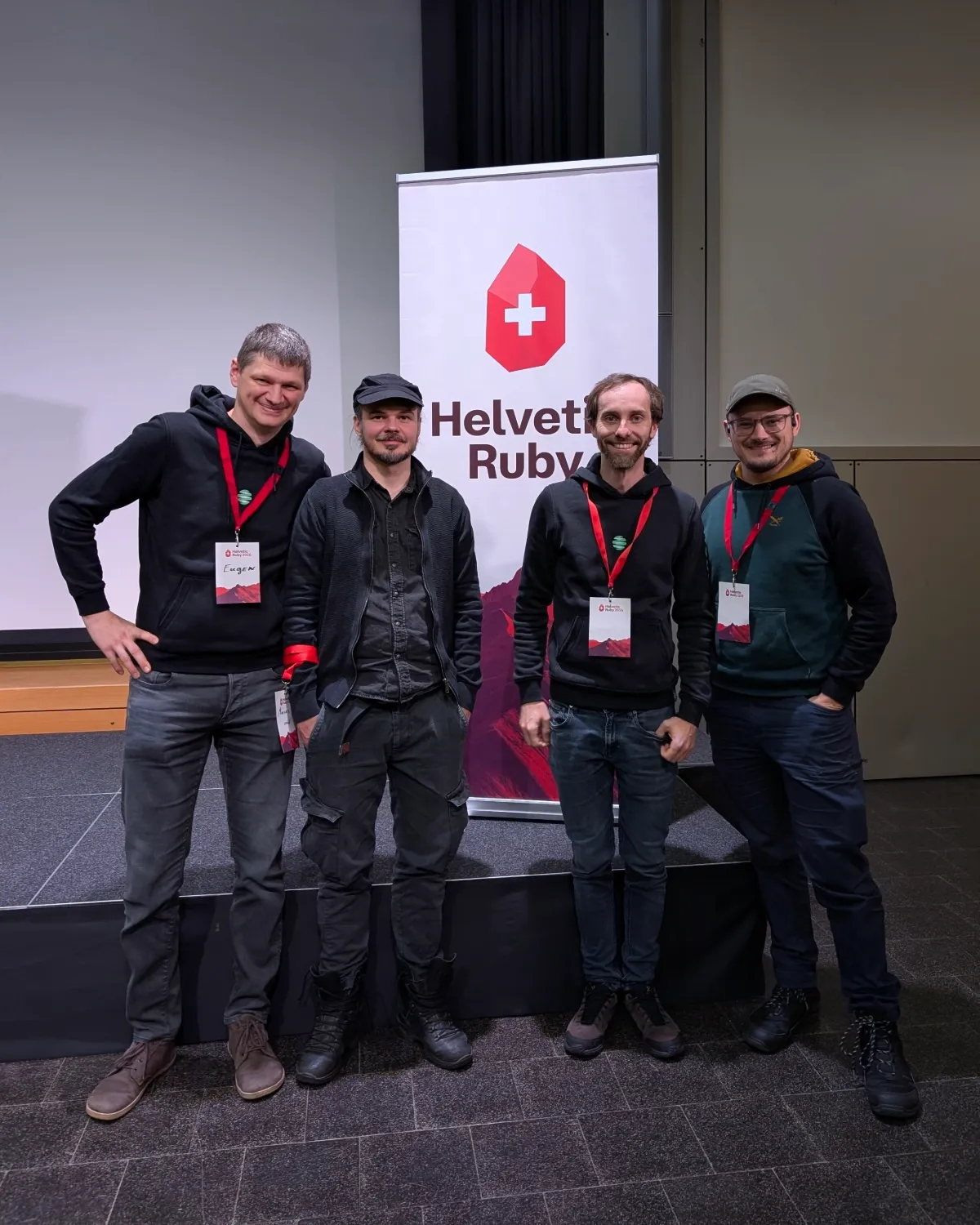
Meanwhile, the other two attended the open-source office hours running in parallel. There, they spoke with Benoit Daloze, the maintainer of TruffleRuby, and Alessandro Rodi, the maintainer of CanCanCan. They gained valuable insights into the work behind these open-source projects.
Why small, frequent Rails upgrades cost less
On Friday, we heard seven talks and several lightning talks. Afterwards, our team named two of them as favourites. Both dealt with legacy issues in applications that had grown over time. The first was 'From Rails 3.0 to Rails Edge - 15 years of Rails upgrades in a 3 million line monolith'. In this talk, Iliana Hadzhiatanasova explained how Fin (formerly Intercom) upgraded its application from Rails 3.0 to the latest version of Rails over a period of 15 years. Around 300 developers and a few monkey patches were involved in the process. This is particularly impressive given that the application is a monolith comprising around three million lines of code. Her key message was: 'The smaller we keep the gap, the cheaper each upgrade is.'
Every skipped version makes the jump bigger at the next upgrade. Furthermore, only current versions receive timely security fixes. In day-to-day work, however, upgrades can easily be overlooked because other tasks seem more urgent. Without clear ownership, they keep getting postponed. In the meantime, monkey patches, which modify third-party code after the fact, are an obvious workaround. According to Hadzhiatanasova, though, these are only a temporary compromise because they merely postpone the real solution and make later updates more complex. This is not a new insight, but it aligns with our own experience.
How costly a large gap can become was demonstrated at the conference itself. On 18 November, the Ruby team had released versions 3.3.14, 3.4.13 and 4.0.10. They close seven security vulnerabilities, including a bug also known as Ruby2ßhell (CVE-2026-132825). It sits in the conversion between upper and lower case in certain character encodings and, in the worst case, can allow external code to be executed. In its security advisory, Ruby rates the vulnerability as critical. Anyone running a current Ruby version could patch while still at the conference. However, there is no fix for Ruby 3.2 and older. The only option is to upgrade across several versions, which becomes more complex and costly with every passing year.
A small version gap has a second advantage. New features can be used early, often avoiding the need to rebuild or adapt certain framework functionality yourself.
Databases can accumulate technical debt, too
The team's second favourite also addressed legacy issues, this time at database level. In 'The database diet that slimmed down our codebase too', Esti Álvarez Otero described how her team overhauled its database. They achieved this by deleting unnecessary data and reducing their indexes by more than 60%. Indexes help a database find entries faster. However, every index takes up storage space and must be updated whenever data changes. Unnecessary indexes therefore cost time and resources.
The punchline is already in the title. For this project, the team traced the origin of each index. This detective work led them back to the application’s Ruby code. There, they came across dead code that had long stopped running. They also found special-case solutions with no current purpose. Along with the database, the codebase was made leaner too.
However, in PostgreSQL, deleting data does not free up any storage. Initially, the database just marks deleted entries as invalid and the space remains occupied. Freeing up the space actually requires separate maintenance steps, such as VACUUM FULL or REINDEX, which need careful planning. Consequently, regular maintenance lowers hosting and maintenance costs in the long term.
Small decisions that will pay off in the long term
Upgrades and database maintenance are ongoing operational tasks. However, the amount of effort required later on is often determined during the development of an application. Three more sessions showed our team this from different angles.
Bot protection without captchas
In his lightning talk, 'Rage Against the Malicious: The Battle of Spam Bots', Alexis Bernard argued that rate limits and captchas alone barely stop botnets. He suggests using Hashcash as an additional measure. Before a form is submitted, the browser solves a small computational puzzle in the background. Humans never notice it, but for bots, each attempt becomes more costly. Hashcash also works without an external service. This eliminates the need for ongoing maintenance of an external service.
One of our developers tried Hashcash on one of his own applications right after the conference. His verdict is sober, though. Hashcash is a useful additional hurdle, but only one of several. Effective bot protection requires combining it with other measures, such as rate limiting, IP blocking, and monitoring suspicious requests.
Good APIs are designed deliberately
In his talk, 'It Works, but There's Something Off', Xavier Noria — author of Zeitwerk and a member of the Rails core team — examined Ruby and Rails features that are reliable in everyday use. However, on closer inspection, their design raises questions. He argued for public APIs that are deliberately and consistently designed. Once others rely on an interface, every change to it becomes costly. One sentence from the talk in particular stuck with our team: 'The moment you assume, you are dead. ' Therefore, interface design should leave no room for assumptions.
Small languages for custom configuration
In his lightning talk, 'We don't use DSLs enough. Here’s why”, Sandro Kalbermatter argued in favour of domain-specific languages (DSLs). These small, specialised languages are particularly easy to build in Ruby. They are particularly useful for configuration. Rather than adhering to the rules and limitations of general-purpose formats such as YAML or JSON, the structure can be precisely tailored to the use case. This makes configurations clearer and ensures they remain readable over time. However, the approach works best with manageable structures. The deeper the nesting, the harder it becomes to keep track.
This Ruby library takes the idea further by applying it to an entire Rails application. The library is still in its infancy and doesn’t quite fit our architecture and projects yet. Nevertheless, we’ll keep an eye on it and take the ideas behind it with us for our applications and the evolution of our architectural patterns.
Here's what we're picking up from Helvetic Ruby 2026
After two days in Zurich, we’ve identified three key points. While they primarily apply to Rails projects, they can also be transferred to web applications built with other technologies.
1. Updates should be part of routine operations.
The message was the same, whether in Fin’s upgrade talk or with Ruby2ßhell. Keeping the gap to current versions as small as possible, and following a regular upgrade process, makes upgrades cheaper and makes security vulnerabilities easier to manage. For us, this confirmed a position we have held for years.
What this means for your application: You can plan and budget for regular upgrades, whereas a major version jump after several years is much harder to manage. They ensure the application remains within security support and makes new features available, often with less custom development. This is why we incorporate upgrades into our projects from the outset and implement them, alongside security patches, as part of our technical support.
2. Cleaning up saves money
Esti Álvarez Otero’s database diet demonstrated that optimisation pays off in two ways. Not only does it take the load off the database, it also makes the code leaner.
What this means for your application: A well-maintained database means lower storage costs and reduced hosting expenses. Every line of code that is removed no longer has to be tested and adapted during upgrades. Each future upgrade becomes cheaper, and regular updates and database maintenance go hand in hand.
3. Decide deliberately, together from the start
Bot protection, well-designed APIs and lean configurations are three examples of decisions that need careful planning and preparation early in the development process. In return, unnecessary dependencies and misunderstandings are avoided from the outset, saving effort in operations.
What this means for your application: The earlier such decisions are made, the less they will cost. Experience from our projects has taught us that questions of security, interfaces and maintainability are best resolved in collaboration with everyone involved. This applies to gathering requirements as much as to design and implementation. This ensures that knowledge from business teams, designers and developers informs every decision, keeping the application easy to run for years to come.
Solid craftsmanship over hype
There were few major announcements in Zurich. Rather than visions of the future, the focus was on experience from applications that have been running and evolving for many years. Much of this aligns with our experience of supporting our clients’ projects. Those who regularly update and clean up their applications save money in the long run. When the next security vulnerability is announced, a small update can be applied quickly.
Thank you to the Helvetic Ruby organising team for two days full of in-depth conversations.
For an overview of our Ruby on Rails projects, see our references.
Share this post